
👨🔬 Governance Lab #118
Lab Report #118 - GnosisDAO’s Treasury Reset, SparkDAO’s Buyback Plan, Lido’s Next Chapter, and more
Welcome back to the Governance Lab, your weekly source for all things StableLab, DeFi, and DAO Governance.
At a Glance 👀
🟦 GnosisDAO passes GIP-143 to offboard kpk as treasury manager
🟨 SparkDAO votes to link surplus treasury to programmatic SPK buybacks
🌊 Lido DAO considers GOOSE-3 strategy to expand beyond staking
🧪 From the Lab: Introducing the GitHub Activity Index
Let’s dive in 🏊
Gnosis DAO
GnosisDAO passes proposal to offboard kpk as treasury manager
GnosisDAO has passed GIP-143, a proposal to terminate kpk’s treasury management mandate with a 14-day transition period. The vote follows weeks of debate over performance, drawdowns, fees, and communication, with delegates weighing whether to tighten the mandate or end the relationship entirely. The final Snapshot result came in at 112k voting power (87.63%) For, 15.8k (12.37%) Abstain, and effectively 0% Against.
The specification directs GnosisDAO to revoke kpk’s Safe signer permissions, stop new treasury operations, and obtain a full handover of positions, strategies, and access controls within 14 days. All assets under kpk management must be moved back to DAO-controlled addresses or withdrawn from kpk products, with ETH allowed to be converted to wstETH and USD to sUSDS or sxDAI to simplify transfers, after which GnosisDAO representatives will consolidate into sUSDS, wstETH, and Gnosis ecosystem tokens. An edit clarifies that mainnet funds are handed over in full, while Gnosis Chain assets enter a “handover state” where non-liquidity funds are returned and remaining liquidity is managed by kpk only for market making until a new provider is selected via RFP, or shifted to full-range Uni v3 positions if kpk exits immediately.
The decision moves a substantial portion of GnosisDAO’s treasury and liquidity setup out of a single external mandate and back under structures defined directly by the DAO. In practical terms, the next phase will hinge on how smoothly the offboarding is executed on mainnet and Gnosis Chain and how quickly the DAO replaces kpk’s liquidity role. Governance participants will be looking for clarity on the RFP process for a new liquidity manager and on follow-up proposals that set a longer-term treasury strategy informed by the GIP-143 discussion.
SparkDAO
SparkDAO votes on SubDAO Proxy plan with programmatic SPK buybacks
Phoenix Labs has put a SubDAO Proxy management plan to a Snapshot vote, framing it as one of Spark’s most important governance decisions to date on treasury use and SPK buybacks. According to the proposal, the SubDAO Proxy has accumulated more than 10M in net revenue since TGE, and the new framework would first reserve funds for risk capital to Sky and operating expenses before routing surplus into SPK purchases. Voting is live until November 27, with the vote currently tracking toward passage.
The plan defines a Target SubDAO Proxy Value based on required risk capital, a governance-set product backstop initially proposed at 5M USDS, and a 24‑month operational runway. Each month, 10 percent of any balance above that target would be used to buy SPK from the market and return it to the proxy, with a 100 percent rate on funds above 200 percent of the target so that large excess balances are converted more quickly into SPK.
If approved, the mechanism would harden how SparkDAO treats surplus revenue by automatically scaling buybacks as excess capital grows, instead of leaving timing and size to ad hoc decisions. The main tradeoff is between keeping larger USDS buffers for risk and runway versus translating more of that surplus into governance exposure and incentive capacity through SPK accumulation. Governance participants will be watching the final Snapshot result on November 27, early buyback volumes once the framework is live, and whether parameters like the 5M backstop, 24‑month runway, and 200 percent threshold need adjustment as Spark’s revenue and product mix evolve.
Lido DAO
Lido DAO considers GOOSE-3 strategy to expand beyond staking
Lido Labs has published the GOOSE-3 strategy proposal, outlining 2026 goals and a three-year vision for Lido DAO’s “next chapter” beyond its current role as the dominant Ethereum liquid staking protocol. The plan centers on vertical expansion “up the stack” into end-user products and horizontal expansion into new asset classes and revenue lines, positioning Lido as a gateway for real-world business use cases. According to the post, this would shift the DAO’s focus from primarily maintaining stETH to developing a broader product portfolio while Lido V3, stVaults, and core decentralization work continue to mature.
The proposal sets three main 2026 goals: expanding the staking ecosystem via stVaults and institutional wrappers (including stETH-based ETPs/ETFs), upgrading Lido Core with Curated Module v2 and Staking Router v3 plus the ValMart validator marketplace, and scaling new DAO revenue streams through Lido Earn. Lido Labs cites expectations of 1M ETH staked via stVaults, a projected +2.6k ETH (~$7.3M) uplift in annual DAO revenue from core upgrades, and a target of $8M in annual recurring revenue from Lido Earn by end-2026, alongside a dual-track execution model of “small bets” and a potential “big bet” in real-business DeFi. Work on LDO alignment via the NEST buyback system is flagged as a parallel track in H1 2026, intended to more tightly link token economics to protocol revenue once the broader strategy is in place.
Forum responses so far generally welcome the clear roadmap but differ on how aggressively Lido should pursue horizontal expansion versus doubling down on staking and stVaults as the primary growth engine. Supportive comments emphasize the opportunity in institutional access and productized yield via Earn vaults, while critics question Lido’s edge in RWA and broader DeFi compared with incumbents and warn about cost, complexity, and governance alignment risks. Next steps are continued forum debate within the GOOSE framework, a complementary EGG execution proposal from contributing entities, and follow-up votes that will decide how much of the proposed expansion, and in which directions, the DAO is prepared to fund and prioritize.
Links
🚀 Launches, Deployments, Partnerships, and M&A
Introducing KlarnaUSD
Fluid DEX v2 is live
📑 Reads, Insights, and Reports
🔒 Security, Risk, & Hacks
Arbitrum DAO - September 2025 Security Council Election: Complete
🧗 Milestones & Updates
Arbitrum DAO - [DIP v1.7] Delegate Incentive Program Results (October 2025)
Arbitrum DAO - OpCo Events Recap
dYdX DAO - Treasury SubDAO Staking Program – Periodic Review #4
Near House of Stake - November Update
🗞️ Everything Else
CoW DAO - CoW DAO Grants 2026 Renewal CI/CD
Sky Ecosystem - Sky Agent Framework: Sky Sentinel Network
📺 Podcasts, Presentations, & Listens
Hayden Adams & Jesse Walden: Breaking Down Uniswap’s Fee Switch and UNIfication Proposal on Bell Curve
Stani Kulechov: Aave Will Be The Biggest Neobank In The World (And What’s Next...) on The Rollup
Ruca & Giel (kpk): Understanding The Risky Business of DeFi’s Risk Curators on The Edge Podcast
Lane Rettig (Near Foundation): Why NEAR Believes Privacy Is the Next Unlock on The Rollup
Proposal Tracker™️
💬 DISCUSSION | dYdX DAO - Liquidation Rebate Pilot Program
Summary: This proposal introduces a 1‑month liquidation rebate pilot that would allocate up to 1M DYDX to rebate liquidation fees to traders via a points-based system, with an initial run targeted to start in early December. The trial is meant to test whether rebating a portion of liquidation fees can improve user experience and trading activity, with results informing any follow-up program.
💬 DISCUSSION | Balancer DAO - Distribution of Rescued Funds from Balancer v2 November 3rd 2025 Attacks
Summary: This RFC proposes distributing roughly 8M in rescued funds from the November 3 v2 exploit to affected LPs using a non-socialized model that reimburses only impacted pools pro rata in the original tokens they deposited. It also sets parameters for white hat bounties and a claims process, with users expected to accept updated terms before receiving reimbursements.
From the Lab
Happy Thanksgiving

We want to wish you a very Happy Thanksgiving from the entire StableLab team, and thank you for being part of our journey. 🦃
The GitHub Activity Index
The GitHub Activity Index is a new tool we’ve built to give grant managers and ecosystem builders a clearer read on how much work is actually being deployed in public over time. In this work highlight, we walk through how the index works, how it normalizes different commit styles, and how you can use it to track builder momentum across your own programs.
❲ Our Voting ❳
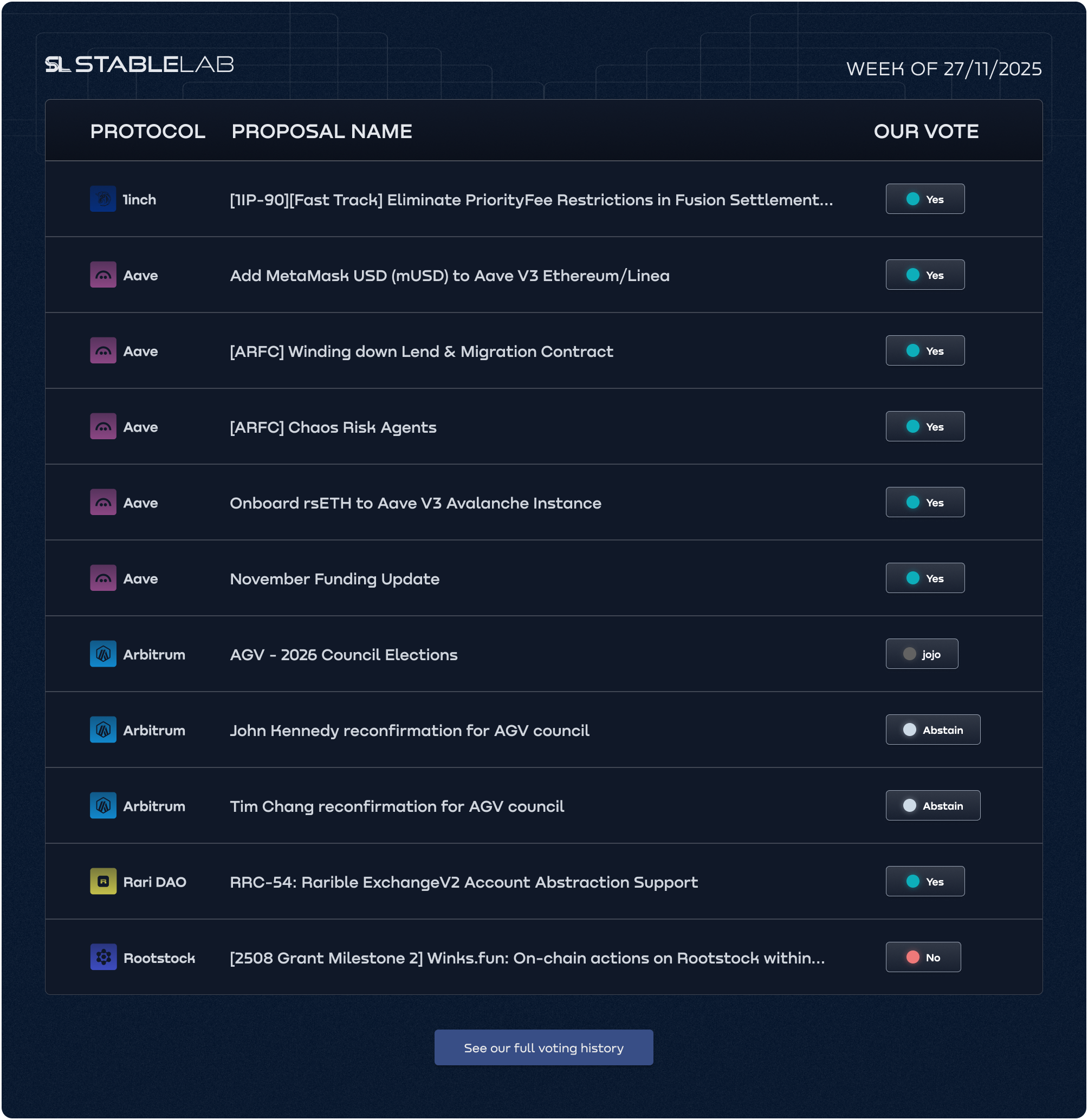
📆 November 21st → November 27th | 🗳️ Total Votes: 11
See our full vote history and detailed rationale HERE.
Meme

💌 FOLLOW US
Website | Twitter | YouTube | Mirror | LinkedIn
🤝 DELEGATE TO US @ stablelab.eth
Tally | Boardroom | Linktree