
👨🔬 Governance Lab #117
Lab Report #117 - Uniswap's UNIfication, Gnosis' Futarchy Pilot, Arbitrum's RAD, and more
Welcome back to the Governance Lab, your weekly source for all things StableLab, DeFi, and DAO Governance.
We’re back after a few weeks of hiatus. Some of us are in Buenos Aires for Devconnect, shoot us a DM to meet.
At a Glance 👀
🦄 Uniswap DAO votes on UNIfication fee switch and UNI burn
🟣 GnosisDAO evaluates 9 month futarchy pilot with 100k liquidity
🟦 Arbitrum DAO considers RAD delegate incentive program
Let’s dive in 🏊
Uniswap DAO
Uniswap DAO votes on UNIfication proposal to turn on protocol fees and burn UNI after years of fee switch debate
Uniswap Labs and the Uniswap Foundation have put forward the UNIfication proposal, which would activate Uniswap’s protocol fee switch and tie UNI more directly to protocol usage after years of discussion among UNI holders and community members about how to align the token with revenue. A Snapshot vote on the proposal is live through November 23, with a majority of votes currently in favor of turning on fees and moving ahead with the broader package at the time of writing.
According to the proposal, Uniswap protocol fees would be turned on and used to burn UNI, with Unichain sequencer fees also routed into the same burn mechanism. The package includes several additional components, including Protocol Fee Discount Auctions (PFDA) that aim to increase LP returns while internalizing MEV, aggregator hooks that would turn Uniswap v4 into an onchain aggregator that collects fees on external liquidity, and a one time burn of 100 million UNI from the treasury that is described as an approximation of what might have been burned if fees had been active since launch.
On the organizational side, UNIfication would focus Uniswap Labs on protocol development and growth by turning off Labs interface, wallet, and API fees and contractually committing to initiatives that align with DUNI interests, while growth and ecosystem work would be funded from the treasury. Most Uniswap Foundation ecosystem teams would move to Labs under this model, with a shared mandate around protocol success and a consolidated growth budget replacing the current split between Labs monetization and Foundation grants.
GnosisDAO
GnosisDAO considers 9 month futarchy pilot with 100k temporary liquidity
GnosisDAO contributors have introduced a proposal that would create a time bound futarchy experiment funded with 100,000 in temporary liquidity to inform governance decisions rather than replace existing processes. According to the proposal, the pilot would run for 9 months and use prediction markets to generate signals about the expected impact of different governance choices, with the DAO retaining final authority over outcomes.
The specification outlines how liquidity would be provided on a temporary basis, the parameters for launching and settling advisory markets, and the roles of any operators or service providers involved in running the system. The authors describe the pilot as a way to test futarchy tooling in a limited scope, with clear boundaries around budget, duration, and the advisory nature of the signals produced.
The document notes potential risks, including market manipulation, low participation, and the complexity of interpreting market data, and suggests that careful metric selection and clear communication would be needed to keep results useful for delegates. The proposal is currently in the discussion stage, with community feedback requested on the pilot design, liquidity size, and whether futarchy should remain purely advisory during this initial experiment.
Arbitrum DAO
Arbitrum DAO considers Rewarding Active Delegates (RAD) program focused on voting and public rationales
Arbitrum DAO has introduced a proposal that would create a per proposal delegate incentive program paying delegates for casting votes and publishing voting rationales, framed as the first component of a new DAO Incentive Program (DIP 2.1). According to the draft, the program aims to increase active voting power, reduce voter apathy, and improve post vote sentiment analysis by tying rewards to both participation and public explanations of how and why delegates voted.
Eligibility would be limited to delegates who opt in, meet a minimum of 200,000 ARB in voting power, vote on a proposal, and post a rationale, with only proposals that follow the Arbitrum Constitution and reach quorum counted for rewards. Quarterly budgets are defined per proposal type with incentive pools and payout caps for on chain constitutional and non constitutional votes, off chain decisions and elections, and temperature checks, and all payouts would be made in ARB using a 7 day TWAP, subject to a 100 USD minimum accrual and a three month expiry on unclaimed small balances.
Funding is expected to come from the roughly 7M ARB currently held in the Delegate Incentive Program multisig, with RAD and related DAO incentive programs absorbing that budget and effectively replacing the existing SeedGov administered Delegate Incentive Program v1.7 as the primary delegate rewards framework over time. In parallel, a separate proposal asks the DAO to temporarily extend DIP v1.7 through February 2026 as a bridge while a successor model is finalized, offering options to reinstate the full program or only Tier X for large delegates. The RAD proposal is currently in the discussion stage, with an offchain vote planned in the coming weeks and a proposed start date that would apply rewards retroactively to proposals conducted on or after November 1, 2025, if approved.
Links
🚀 Launches, Deployments, Partnerships, and M&A
Introducing Aave App
Introducing Obex, Y-Combinator for Stablecoins
Continuous Clearing Auctions: Bootstrapping Liquidity on Uniswap v4
Introducing the Lido stRATEGY Vault
Announcing Aero
Gnosis launches rebrand
1inch launches Aqua
📑 Reads, Insights, and Reports
🔒 Security, Risk, & Hacks
Aave DAO - Chaos Risk Agents
Balancer - Nov 3 Exploit Post-Mortem
🧗 Milestones & Updates
Arbitrum DAO - OpCo/OAT Bi-annual Transparency Report October 2025
Arbitrum DAO - Entropy Advisors Monthly Update: October 2025
Arbitrum DAO - Treasury Management: Investment Policy Statement [Q4 2025]
🗞️ Everything Else
Aave DAO - Focussing the Aave V3 Multichain Strategy
Arbitrum DAO - Temporary Extension of the Delegate Incentive Program (DIP) v1.7
Gnosis DAO - Kpk Terms of Service November 2025
Jito DAO - Ensure JitoSOL Participation in Solana Level Governance
Near House of Stake - AI Governance Dashboard (Alpha)
Lido DAO - Liquid Buybacks: NEST execution with LDO/wstETH liquidity
Sky Ecosystem - Sky Agent Framework: Protocol Roadmap
Spark - Modify Delegate Framework
ZKsync - From Governance to Utility: $ZK Token Proposal, Part I
Proposal Tracker™️
✅ VOTE PASSED | dYdX DAO - Adjust Protocol Revenue Sharing
Summary: This proposal updates dYdX protocol revenue distribution by directing 75% of revenue to the Buy & Stake Program, 5% to MegaVault, 5% to the Treasury SubDAO, and 15% to stakers and validators, replacing the previous 25/25/10/40 split and narrowing MegaVault’s role to liquidity on newly listed markets. The change follows a prior non binding text proposal signaling support for allocating a larger share of protocol revenue to buybacks and has now been approved on chain as Proposal 313 on the dYdX chain.
💬 DISCUSSION | Jito DAO – Update the NCN Grants Programme and Commit to Futarchy Experimentation
Summary: This proposal asks Jito DAO to extend and update the NCN Grants Programme by allowing the existing committee to retain control of the remaining 1.7M JTO from the original 2M budget and use it for continued futarchy based grant experiments. It removes tight constraints on the initial grant structure while keeping rigorous selection standards, commits the DAO to a longer timeline of futarchy experimentation, and adds two core contributors to the grant committee for design and oversight. The proposal requests no new funds and frames the extension as a way to refine market based grant evaluation after a cautious first year that funded a single NCN project.
From the Lab
Reintroducing Forse: The Intelligence Layer Fueling Web3 Growth

We are reintroducing Forse as the intelligence layer where growth data and automation meet for web3 operators. Forse gives teams a single source of truth for growth and an execution layer to act on it, unifying onchain, offchain, and proprietary data into modular analytics and context engineered agents that prove impact and run programs. Insights is live today and Agents are in private beta with teams running grants, incentives, and broader growth programs that want clearer attribution and safer automation. If you are scaling these programs and want to understand what really drives TVL, usage, or builder momentum, we want to talk.
▶︎ Read our full announcement
▶︎ Book a Forse Demo
Team Offsite Bodrum Edition
Last month, our fully remote team gathered along the Turkish Riviera to align on strategy, roadmap, and priorities. Take a look at some of the moments we shared. 💙
Meet us at Devconnect
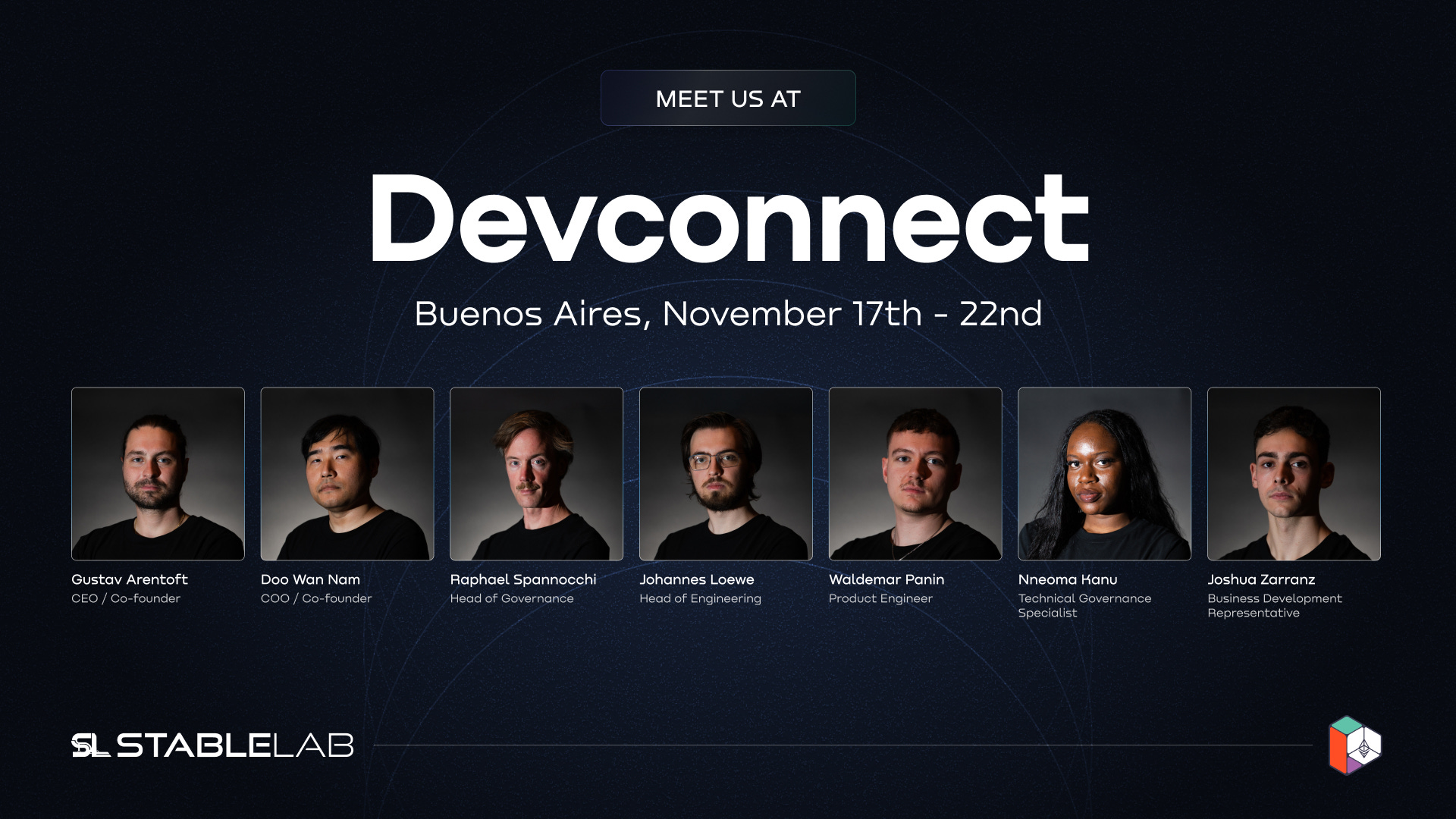
Some of the StableLab team is currently in Buenos Aires for Devconnect meeting with teams, partners, and frens to showcase Forse. If you’re around and building grants, incentive systems, or governance, DM us to meet!
Podcast - Keel Scaling Solana’s Capital Engine
On the latest StablePod episode, we’re joined by Cian Breathnach, Founder of Matiriki Labs and contributor to Keel, Solana’s capital engine. We discuss how Keel approaches capital efficiency, the role of governance in shaping risk frameworks, and what Solana specific constraints mean for protocol design and incentive programs.
▶︎ 📺 Watch on YouTube
▶︎ 🎧 Listen on Spotify and Apple
❲ Our Voting ❳
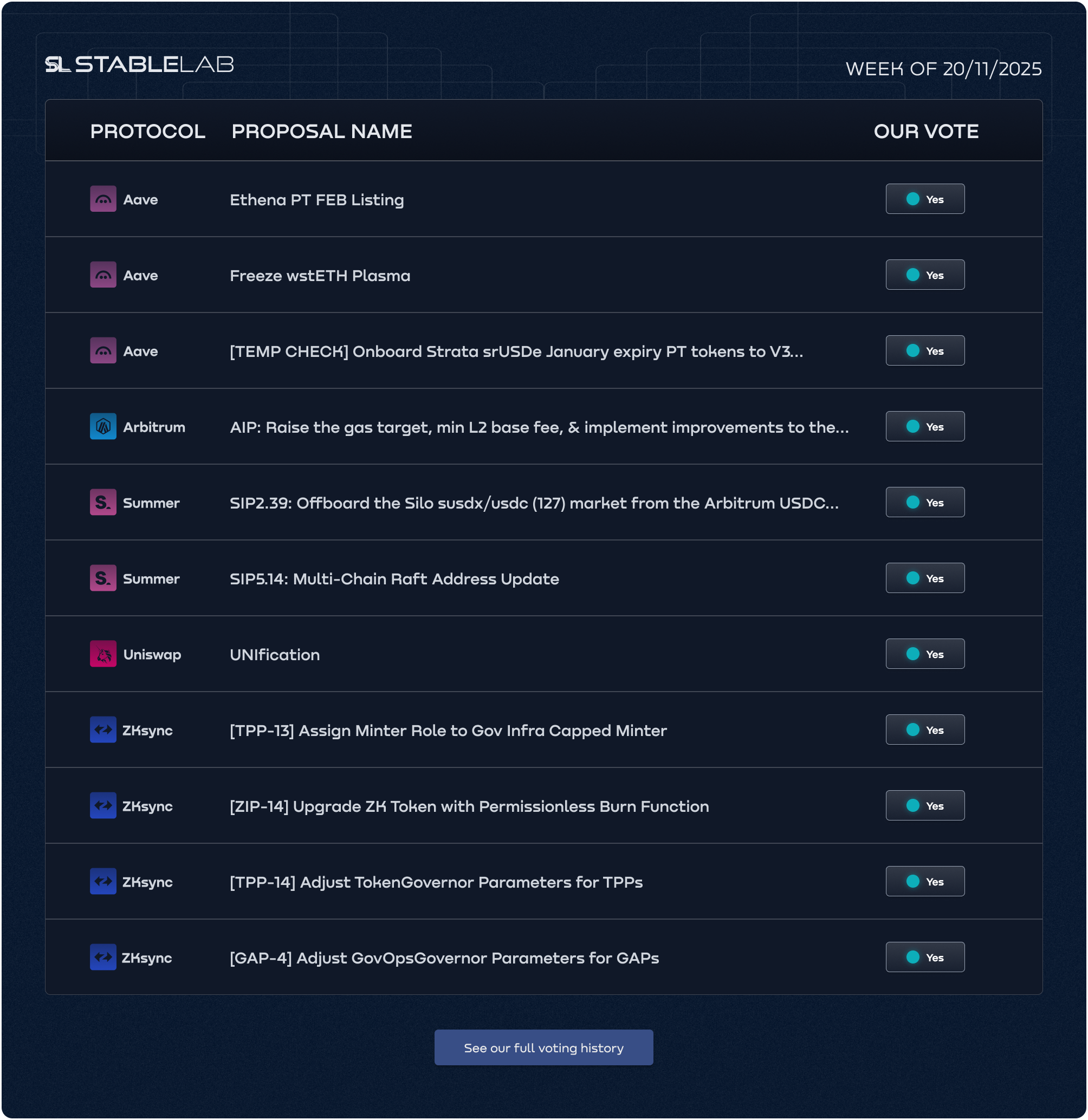
📆 November 14th → November 20th | 🗳️ Total Votes: 11
See our full vote history and detailed rationale HERE.
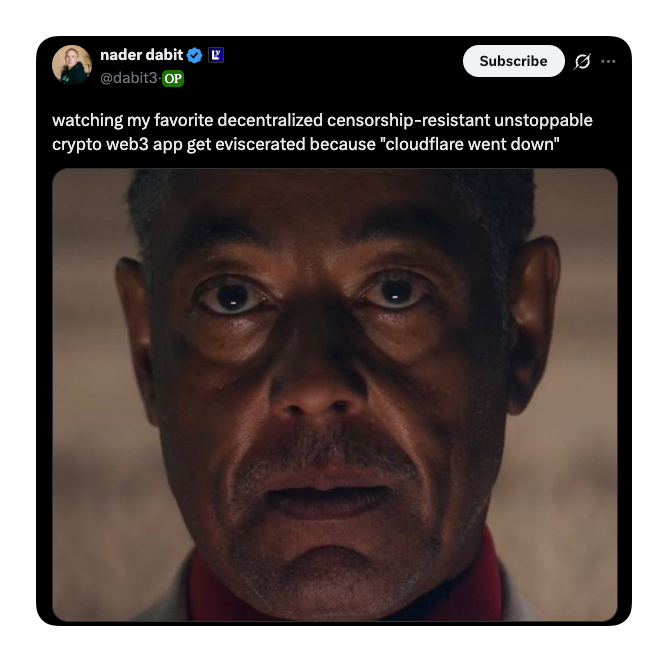
Meme

💌 FOLLOW US
Website | Twitter | YouTube | Mirror | LinkedIn
🤝 DELEGATE TO US @ stablelab.eth
Tally | Boardroom | Linktree